

The ancient rhythm of fasting, gratitude, harvest and seasonal reckoning that once paused the year four times
There used to be pauses built into the year. (Sounds pretty good to me, right?)
Not holidays, exactly. Not festivals in the way we usually think of them, either.
Four times each year, people in the Western Christian world entered a strange little pocket of time called Embertide.
Wednesday, Friday and Saturday were set apart. Work still happened. Meals still had to be made. Animals still needed tending. But ordinary time was interrupted by fasting, prayer and attention to the season that was changing outside the door.
These were the Ember Days.
If you’ve never heard of them, you’re hardly alone. They’ve largely disappeared from modern calendars, even though for centuries they helped structure the year across Europe.
And the September Ember Days may be the most interesting of all.
They arrive near the Autumn Equinox, when gardens are giving their last great push, orchards are heavy, grapes are being gathered and the light has begun making its unmistakable turn toward winter.
Which makes Embertide worth remembering even if you have no intention of recreating a medieval Catholic fast.
Because underneath the rules and liturgy is an idea we’ve become remarkably bad at practicing: Notice when the season changes. Stop long enough to honor it.
So, What Exactly Are Ember Days?

The traditional Ember Days are four sets of observances scattered through the year.
Their Latin name was quattuor tempora, meaning roughly “the four times” or “four seasons.” Each Embertide contained three days of special observance: Wednesday, Friday and Saturday.
Eventually, their timing became attached to particular points in the Christian calendar.
One occurred during Lent. Another followed Pentecost. The September Ember Days came after the Feast of the Exaltation of the Holy Cross on September 14. Winter Embertide fell in December near the feast of St. Lucy.
Together they created something like seasonal hinges within the church year.
The English word ember is way more mysterious than it sounds. It actually has nothing to do with glowing coals.
One possibility traces it to Old English words associated with a cycle or circuit of time. Another explanation connects it indirectly to quattuor tempora through related European forms such as the German Quatember. Even historical dictionaries disagree about exactly how we ended up with “Ember Days.”
Which is strangely appropriate. We remember the name, barely. We’ve mostly forgotten what it marked. (Largely based on Talley, 1992; Adam, 1990.)
Ember Days Are Older Than Most People Realize

The history gets murky very quickly.
Seasonal fasts were already being observed in Rome during late antiquity. Pope Leo I, who served from 440 to 461 CE, preached sermons about them as an established practice.
By the time of Pope Gelasius I later in the fifth century, four seasonal observances appear in the record.
That makes some form of Embertide roughly fifteen centuries old.
The exact arrangement continued evolving for hundreds of years. The practice spread from Rome into other parts of Western Europe, although different regions adopted it at different times. By the medieval period, Ember Days had become deeply woven into the Western liturgical calendar.
They also became associated with the ordination of clergy. Ember Saturdays developed elaborate vigils, and candidates for holy orders could be ordained during them.
But that ecclesiastical history sits beside another layer that’s especially interesting for anyone who pays attention to seasonal tradition. Embertide was also about the Earth. (Talley, 1992; Willis, 1964.)
Were Ember Days Originally Pagan Harvest Festivals?

Here we need to resist a really tempting story.
You’ll often read that the early Church simply took Roman agricultural festivals and converted them into Christian Ember Days.
I mean, it’s totally possible that Roman seasonal customs influenced their development. Ancient Rome certainly had agricultural observances connected with sowing, harvest and the vintage. Older histories of the Ember Days made that connection very directly.
Modern scholarship is more cautious.
Liturgical historian Thomas Talley argued that the evidence doesn’t allow us to trace Ember Days neatly back to one pagan festival or even prove that agricultural ritual was their original purpose. Geoffrey Willis likewise explored a complicated development within the Roman liturgy itself.
In other words, there probably wasn’t a meeting where somebody said, “The Romans already have a harvest festival on Tuesday. Let’s put a saint on it.”
History is almost never that cooperative.
What we can say is that Ember Days developed in an agricultural society where seasonal change mattered enormously. Their prayers came to speak very naturally about the fruits of the Earth. Later explanations explicitly connected the observance with gratitude for nature’s abundance, moderation in using it and care for people in need.
Those themes stuck. And by the medieval period, Embertide had unquestionably become one of the ways people marked the agricultural year. (Talley, 1990; Talley, 1992; Willis, 1964.)
The September Ember Days and the Harvest

September Embertide was traditionally associated with the autumn harvest, especially the vintage.
Think about the timing for a sec.
The Feast of the Exaltation of the Holy Cross falls on September 14. The autumn Ember Days follow shortly afterward. That places them very close to the Autumn Equinox.
Not exactly on it. This wasn’t an equinox festival. But seasonally, the correspondence is hard to miss.
Across much of Europe, this was a time of gathering. Grapes ripened. Fruit came in. Stored food became increasingly important. What had grown through spring and summer was being measured against what would be needed during winter.
The spiritual questions almost write themselves:
- What did the land give this year?
- What do we actually need?
- What can be shared?
- What needs to be stored?
- What deserves thanks before we rush onward?
That is the piece of Embertide I find most compelling. Harvest wasn’t treated only as acquisition. It was followed by reckoning.
Why Fast During a Harvest?

At first glance, fasting during a season of abundance sounds backward.
The fields are full, so…eat less?
But that tension may be the whole point.
Fasting turns abundance into something noticeable.
If food is simply available, it’s easy to consume without thinking much about where it came from. Voluntary restraint changes your relationship with it. Suddenly the meal has edges.
Older explanations of the Ember fasts repeatedly connect abstinence with moderation and almsgiving. You receive what the Earth has produced, but you don’t assume that everything available therefore belongs to you.
Some of what you have can become someone else’s supper.
That creates a very different harvest ethic from the modern version, which tends to stop at gratitude.
Gratitude is lovely. And it changes what you do with the idea of a harvest.
Of course, historical fasting rules varied by period and place, and there’s no spiritual prize for ignoring what your body needs. A modern Ember practice doesn’t require food restriction at all.
“Fast” can also mean deliberately stepping away from excess.
That may be an even more useful question now: What am I consuming because it’s necessary? And what am I consuming because I’ve forgotten how to stop?
Why Wednesday, Friday and Saturday?

This pattern predates the Ember Days themselves.
Wednesday and Friday had been important Christian fasting days very early in the Church’s history. They appear as such in the Didache, one of the oldest surviving Christian texts outside the New Testament.
Saturday was eventually added to the seasonal observance in Rome.
So an Ember week wasn’t one long retreat from ordinary life. It breathed.
Wednesday interrupted the week.
Thursday returned you to ordinary time.
Friday brought you back.
And Saturday deepened the observance before Sunday.
I love that structure because it doesn’t require escaping your life in order to notice your life.
The sacred days are threaded through everything else.
You still milk the cow. You still answer the door. You still have bread dough rising on the counter.
But the week has changed because you’ve decided that several moments inside it mean something.
Ember Days Were Also About Community

There’s another part of the old tradition that deserves recovering.
Embertide wasn’t purely personal. The older understanding included almsgiving and concern for people who didn’t have enough. Seasonal gratitude carried a social obligation with it.
That makes sense in a farming culture. A good harvest rarely belongs entirely to one person. Seed came from somewhere. Labor came from somewhere. Rain certainly wasn’t yours to command.
The whole system reminded people that abundance was relational.
We’ve largely preserved the gratitude part of harvest spirituality while stripping away the redistribution part.
A beautiful basket of apples on an altar is meaningful. Giving half the apples to someone who needs them might be closer to the original spirit. You with me?
The Four Ember Seasons Made the Year Feel Different

This is where the practice becomes much larger than a few fasting days.
Ember Days created regular checkpoints. Instead of moving through the year as one long blur punctuated by holidays, people encountered several deliberate interruptions.
The season had changed. Pay attention.
That repetition mattered.
Spring asks different things of us than autumn does.
The body knows this. The garden definitely knows this. Animals know this without needing a calendar notification.
Human beings are remarkably good at overriding it.
We heat February like May. We light December like June. Strawberries appear in grocery stores while snow is falling outside.
Convenient? Absolutely. Disorienting? Also, yes.
One of the great gifts of old seasonal calendars is that they keep insisting that time has texture.
September isn’t February with different decorations.
Why Did Ember Days Disappear?

They never vanished entirely.
Traditional Catholic communities still observe them, and the modern Roman Catholic liturgy leaves room for local bishops’ conferences to determine how Ember Days and similar seasonal observances may be celebrated.
But their prominence changed dramatically during twentieth-century liturgical reforms.
Mandatory Ember fasting had already been removed from universal Catholic penitential law in the 1960s. Changes to the liturgical calendar followed, and in many places ordinary Catholics simply stopped encountering Embertide.
Once a ritual disappears from the calendar, cultural memory can go remarkably fast.
A generation misses it. Then the next generation doesn’t know there was something to miss.
Which is more or less how you wind up reading an article in 2026 called What Are Ember Days?
The September Ember Days in 2026
If you want to watch the old calendar move beneath the modern one this year, the autumn Ember Days fall on:
- Wednesday, September 16, 2026
- Friday, September 18, 2026
- Saturday, September 19, 2026
The timing is lovely this year because the Autumn Equinox follows only a few days later, on September 22. That creates almost a full week of threshold energy.
Not because the old Ember calendar was secretly designed around modern equinox spirituality. It wasn’t.
It’s simply what happens when several old ways of noticing seasonal change gather in roughly the same patch of September.
A Modern Ember Practice

You don’t need to become a medieval monk for three days. Please don’t. (Or do, and send me pics lol.)
Instead, borrow the underlying rhythm.
On Wednesday, notice.
Walk your land if you have some. Walk your neighborhood if you don’t. Look carefully at what September is actually doing where you live:
- What’s blooming?
- What’s already gone to seed?
- Which birds are moving?
- What smells different?
- What feels like it’s finished and done with?
Then take that awareness home.
Friday can become the quieter day.
Eat simply if that practice is appropriate for you. Reduce some other form of consumption (social media, shopping, etc.) if it isn’t. Turn off the constant incoming noise for a while.
Spend less. Buy nothing unnecessary. Use what’s already in your pantry.
The old practice of restraint makes far more sense when it becomes specific.
Saturday is a beautiful day for gratitude expressed through action:
- Give food away.
- Donate something useful.
- Preserve part of the harvest.
- Clean the kitchen.
- Bring flowers or herbs to an ancestor altar.
- Return something organic to the land.
Make your gratitude material. That matters.
A Simple September Ember Ritual
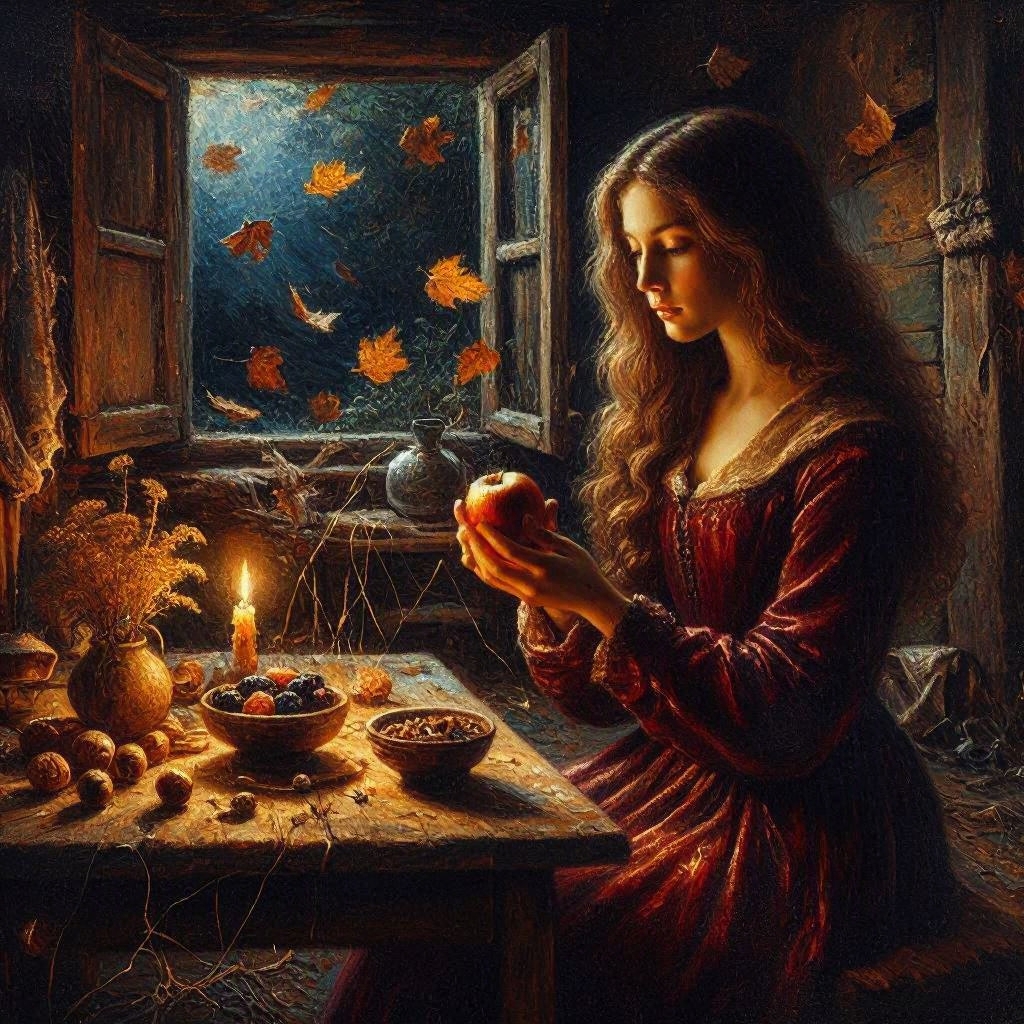
Sometime during those three days, place something seasonal on your altar or table.
Doesn’t have to be anything fancy.
An apple from a local orchard. A handful of acorns. A sprig of goldenrod. A jar of something you preserved. A tomato from the garden that absolutely refuses to admit summer is ending.
Light a candle (doesn’t matter what color). Then ask: What’s grown since spring?
Stay there for a while.
Not what did you achieve. What GREW?
Those aren’t always the same thing.
Something may have matured quietly. (A boundary, a relationship, a skill, a part of yourself that finally stopped apologizing for existing, etc. etc.)
Then ask what needs gathering before the season changes.
And finally, what can be given away?
That last question belongs here.
Harvest magic gets strange when everything moves inward. Some things are meant to become stores. Some are meant to become seed. And some are meant to leave your hands entirely.
Embertide as Threshold

We’ve lost surprisingly few seasons. But we’ve lost countless ways of entering them.
That’s different.
Autumn still comes whether we acknowledge it or not. Trees begin shutting down chlorophyll production. Migrating animals move. Fungi rise from wet soil. Daylight contracts.
The old calendars simply gave human beings something to do in response.
Ring a bell. Change the food. Say a prayer. Pause your ordinary routine. Mark the threshold.
Ember Days were one answer.
I don’t think recovering them means pretending we still live in medieval Europe. Nor does it require adopting beliefs that aren’t yours.
The more interesting recovery is the habit underneath the ritual.
Several times each year, stop. Look outside. Ask what the season has given and what it’s asking now.
That may be the oldest magic in the whole thing. (And maybe the part we need most.)
References
Adam, Adolf. The Liturgical Year: Its History and Its Meaning After the Reform of the Liturgy. Translated by Matthew J. O’Connell. Liturgical Press, 1990.
Bradshaw, Paul F., and Maxwell E. Johnson. The Origins of Feasts, Fasts and Seasons in Early Christianity. SPCK, 2011.
Buchinger, Harald. “On the Origin and Development of the Liturgical Year: Tendencies, Results, and Desiderata of Heortological Research.” Studia Liturgica, vol. 40, 2010, pp. 14–45.
Talley, Thomas J. The Origins of the Liturgical Year. Revised edition. Liturgical Press, 1992.
Talley, Thomas J. “The Origin of the Ember Days: An Inconclusive Postscript.” In Rituels: Mélanges offerts à Pierre-Marie Gy, edited by Paul De Clerck and Éric Palazzo, Cerf, 1990, pp. 465–472.
Willis, Geoffrey Grimshaw. “Ember Days.” In Essays in Early Roman Liturgy. Alcuin Club Collections, 1964.
Disclaimer
This article explores Ember Days from historical, folkloric and spiritual perspectives. Religious practices have varied widely across time, place and denomination. Any modern observance described here is offered as personal spiritual practice rather than religious instruction. Fasting isn’t appropriate for everyone; adapt or skip it according to your health, needs and traditions. Nothing in this post constitutes medical or mental health advice or guarantees any outcomes.